
Six capabilities, one application
TRIZ studio is one package: every feature comes with every license. TRIZ studio capabilities follow the natural order of a TRIZ study: define, find the contradiction, solve, go deeper, report — and learn TRIZ.
Problem Study and Roadmap
Define a real problem and let the 9-step roadmap guide you step by step.
Explore Find the contradictionTechnical Contradiction and Contradiction Matrix
Translate the problem into the language of TRIZ: which parameter worsens as another improves?
Explore SolveInventive Principles, IFR and Solutions
Apply the principle to your problem, write the Ideal Final Result, track the solution ideas.
Explore Go deeperExtended TRIZ Toolkit
When the fast track is not enough: 9 Windows, function, resources, physical contradiction, Su-Field and evolution trends.
Explore ReportARIZ, Advisor Comment and Report
The 9-stage ARIZ for complex problems, a TRIZ advisor comment and a PDF report in a single file.
Explore LearnTraining: Concepts, Cases, Practice
Learn and teach TRIZ: concepts, reference lists, example cases and practice exercises.
ExploreProblem Study and Roadmap
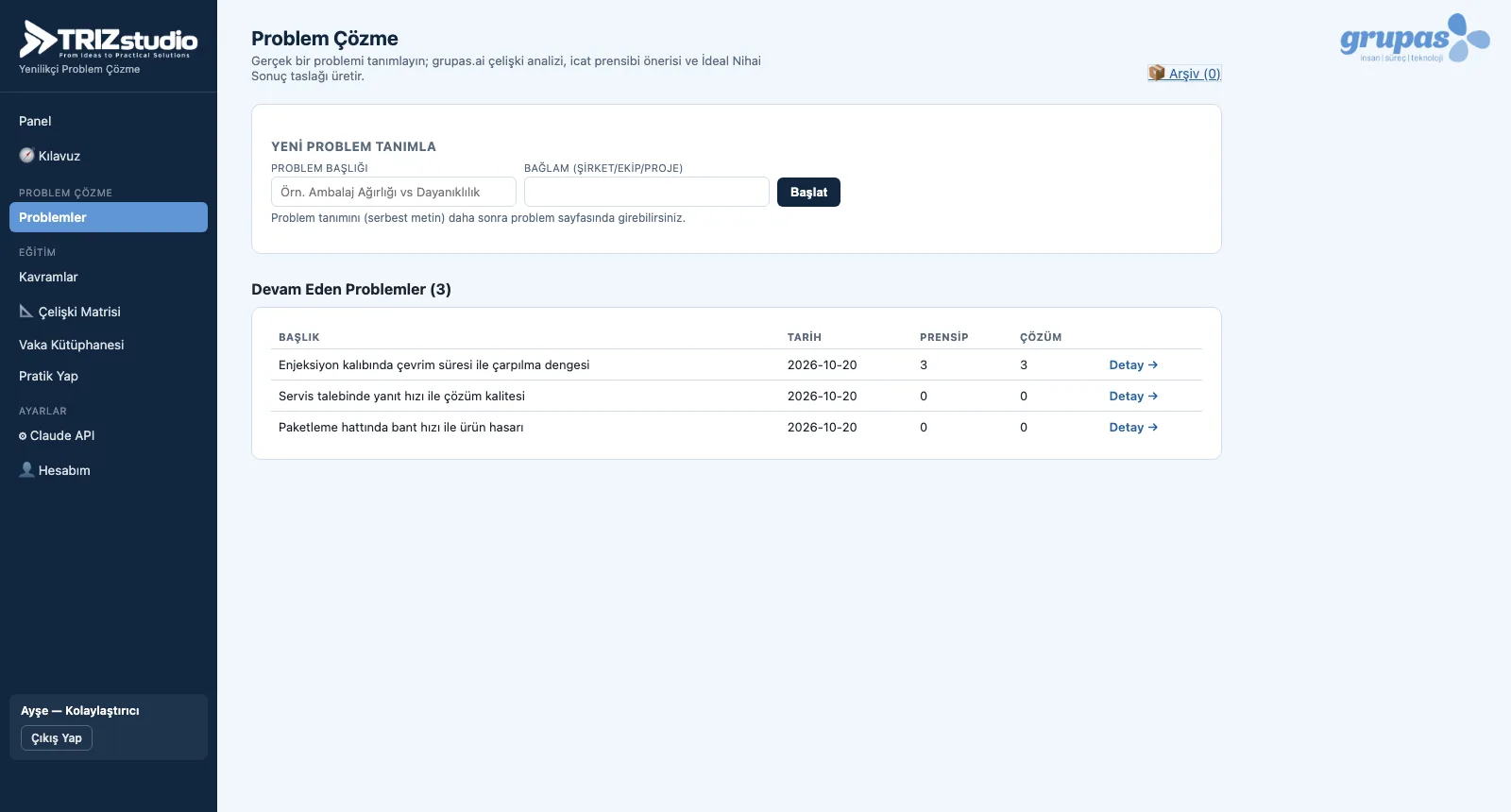
Every problem study opens with a title, a context and a concrete problem statement. The Progress Guide matches the nine steps of the guide (from the 9 Windows to ARIZ) with this problem's data: it shows which steps are done and which step is recommended next. If you wish, grupas.ai suggests the next step and the steps you can skip for your problem, with its reasons.
- Problem record: title, context (team / project) and a measurable problem statement
- Progress Guide: a done / next marker for each of the 9 steps
- grupas.ai next-step recommendation: reasons and skippable steps, applied only once you confirm
- Step-by-step guide: the purpose of each step, how and when to use it; a fast track and a deep track
- Complete and archive, reopen; ongoing and archived problems are listed separately
Technical Contradiction and Contradiction Matrix
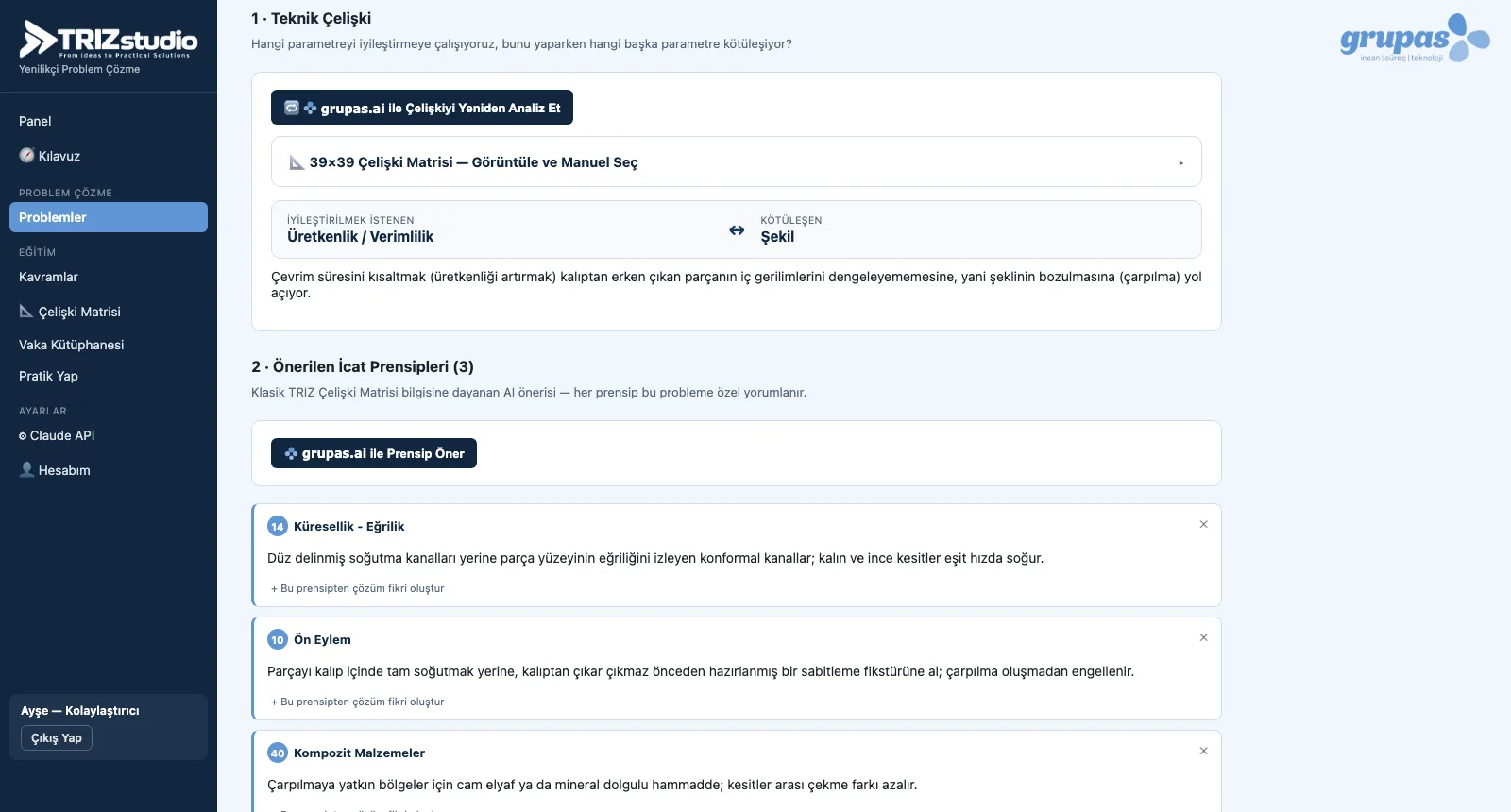
A technical contradiction is defined by two parameters: the one you want to improve and the one that worsens as a result, both chosen from the 39 standard engineering parameters. grupas.ai identifies the contradiction from your problem statement, or you pick the pair yourself from the matrix. If the pair is recorded in Altshuller's classic 39×39 Contradiction Matrix, the inventive principles come straight from the matrix.
- Contradiction detection with grupas.ai: the improving and the worsening parameter, with the reasoning
- Embedded 39×39 matrix: clicking a cell selects the pair and shows the names of the principles in it
- Manual selection: pick the two parameters from the list and get principles for that pair
- Transparent source: it is stated clearly whether the principles come from the classic matrix or were suggested by AI because the pair has no entry in the matrix
- Reference pages: the full list of the 39 parameters and the complete matrix table
Inventive Principles, IFR and Solutions
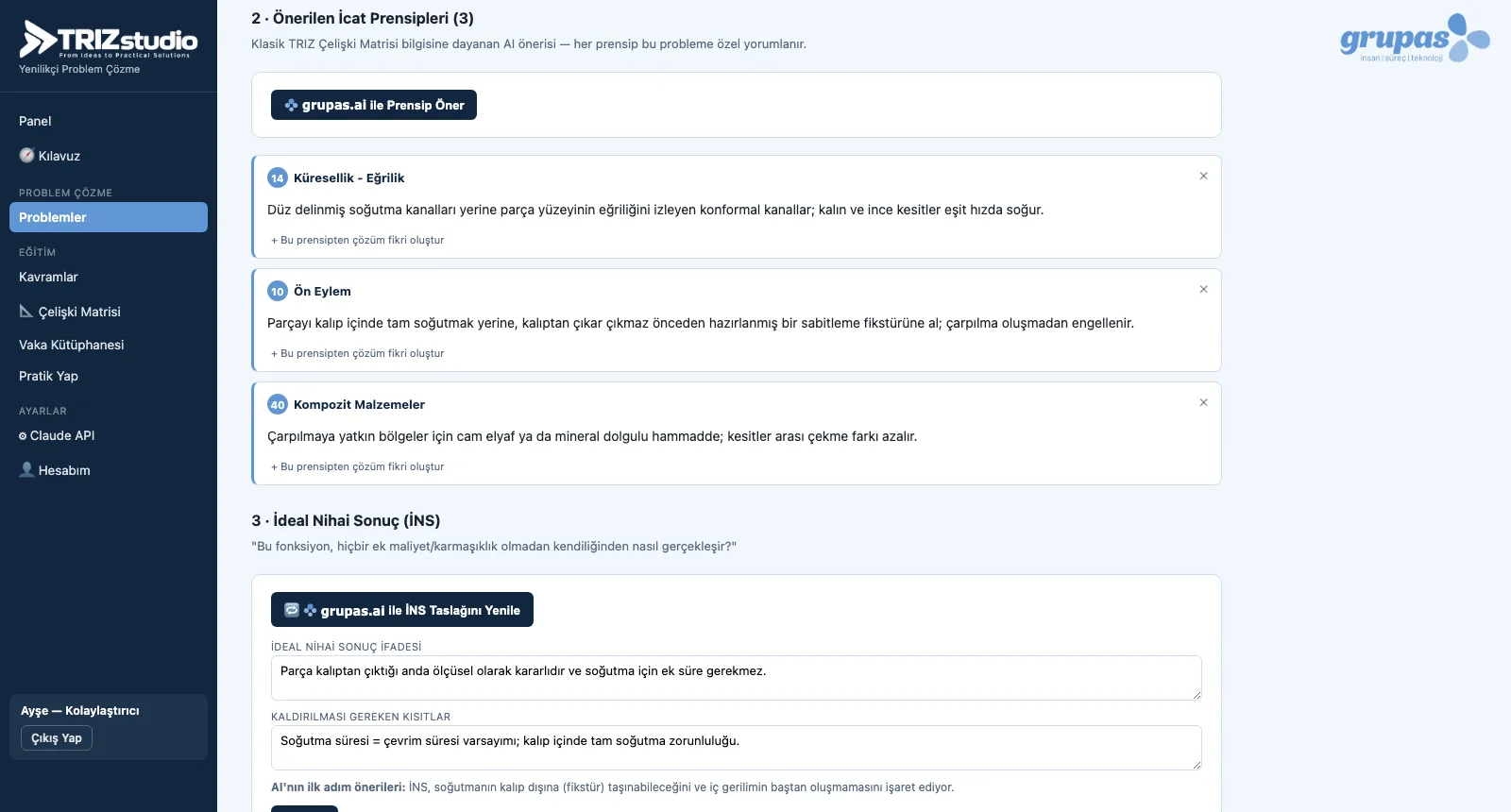
Each inventive principle from the matrix is explained with an application suggestion specific to this problem; you choose which ones to add to the study. The Ideal Final Result (IFR) sets an ideality reference with the question 'how would this function happen by itself, at no extra cost?'. Concrete ideas arising from the principles are tracked through the statuses Idea → Selected → Implemented.
- 40 inventive principles: each with its number, name, description and examples
- Problem-specific application suggestions; review them and add the ones you choose
- Ideal Final Result: the IFR statement, the constraints to remove and first-step suggestions — editable by hand
- Solution ideas: recorded against the related principle with an Idea / Selected / Implemented status
- Create a solution idea based on a principle in one click from its card
Extended TRIZ Toolkit
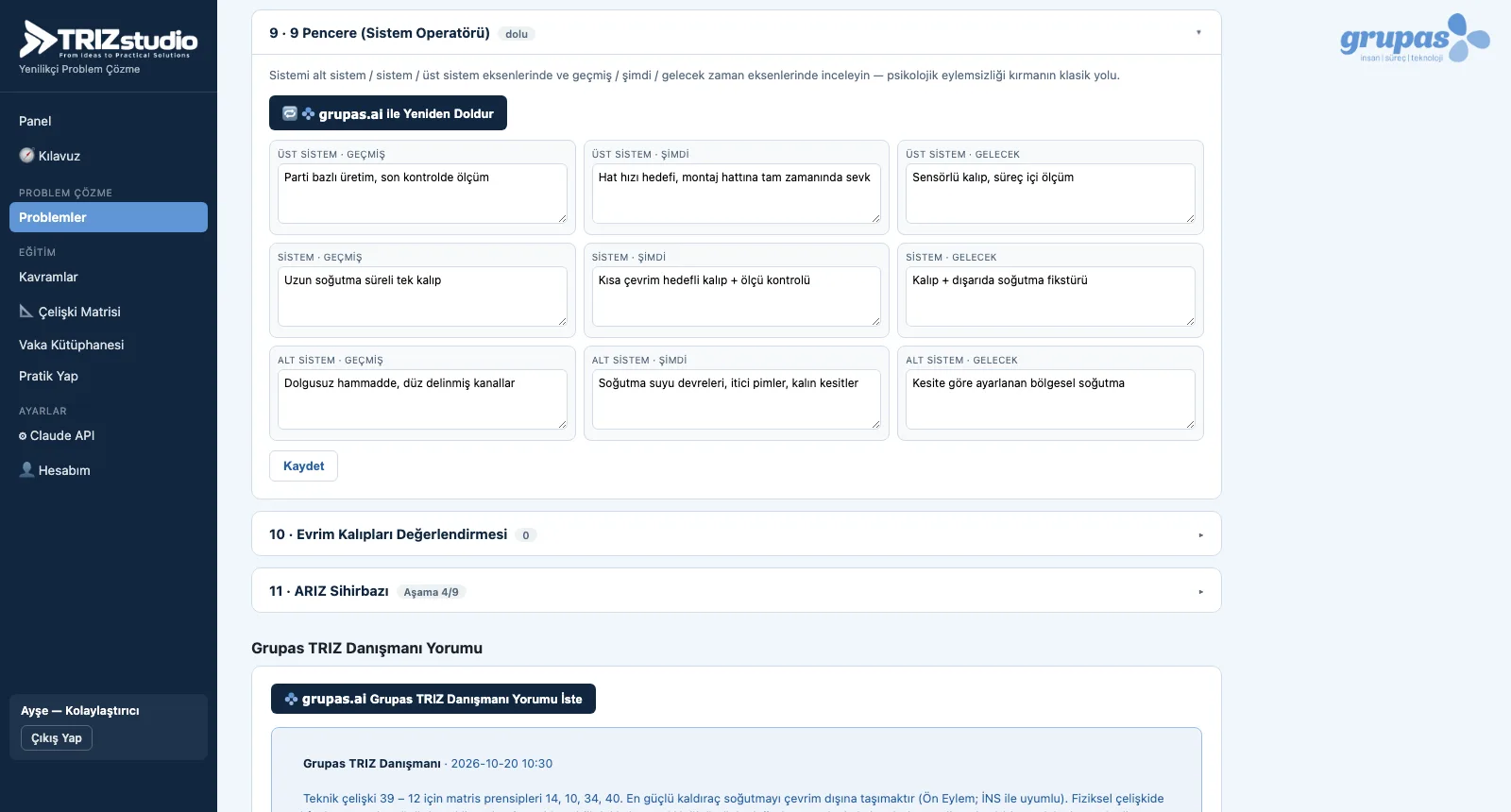
The extended toolkit gathers the classic TRIZ tools in expandable panels on the same problem page, to see the problem in a wider frame and solve it at the root. You can start each tool with grupas.ai or fill in the fields yourself; completed tools show as done in the Progress Guide.
- 9 Windows (System Operator): subsystem / system / supersystem × past / present / future
- Function Analysis: the relation between pairs of components — useful adequate, useful insufficient, useful excessive, harmful
- Resource Analysis: substance, field / energy, space, time and information resources, each with a usage idea
- Physical Contradiction: resolved by separation in time, in space, between whole and parts, or on condition
- Su-Field: diagnosis of the S1–S2 interaction and a suggested class of standard solution
- Evolution Trends: where the system stands today and its likely next evolution step
ARIZ, Advisor Comment and Report
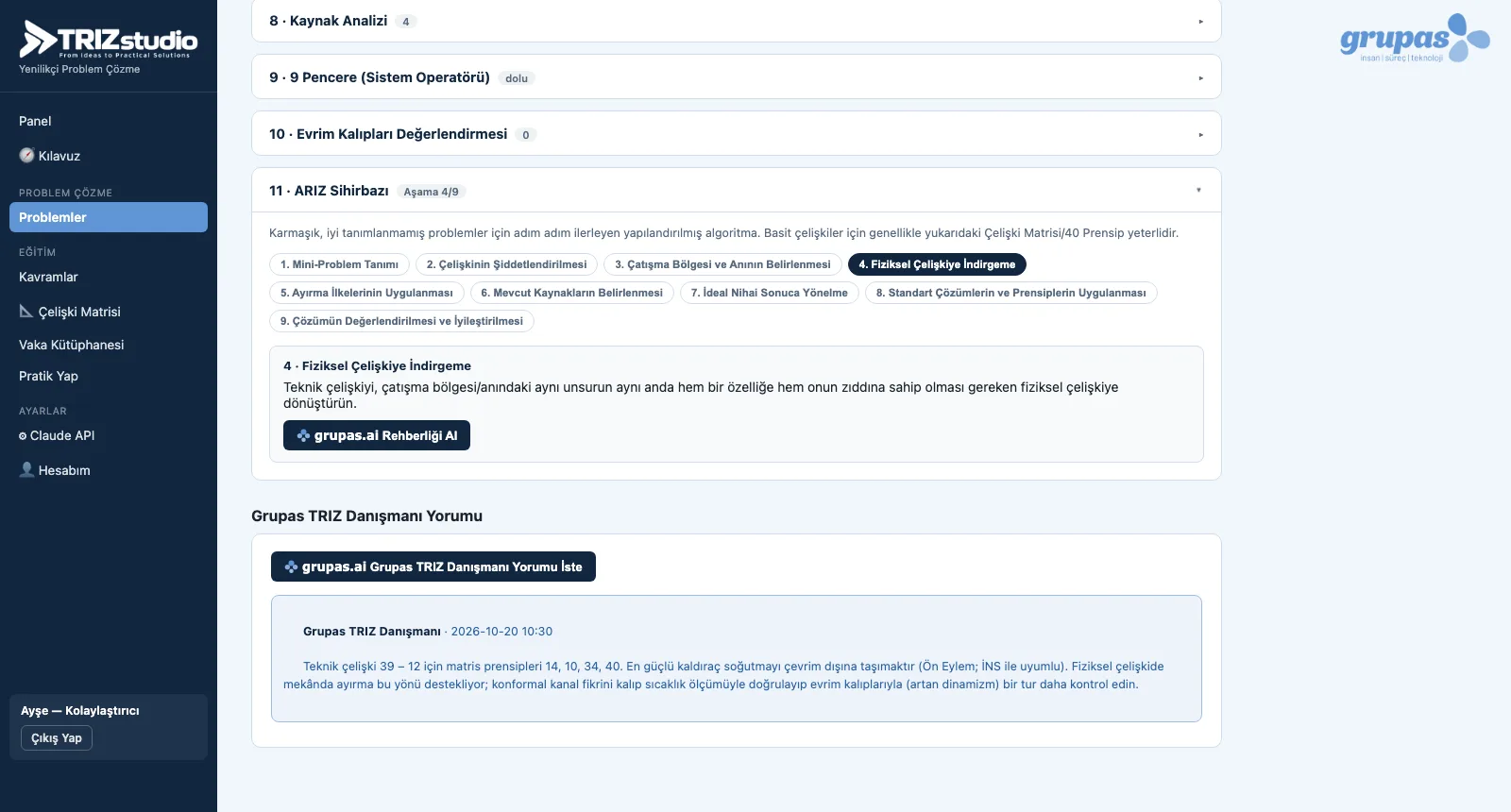
The ARIZ Wizard takes ill-defined or multi-component problems through nine stages, from the mini-problem statement to the evaluation of the solution; grupas.ai offers guidance at every stage. The Grupas TRIZ Advisor reads the progress of the study so far and writes a comment. From the contradiction to the solutions and toolkit outputs, the study is collected in a single PDF report.
- The 9 stages of ARIZ: mini-problem, intensifying the contradiction, conflict zone and time, reduction to a physical contradiction, separation principles, resources, moving towards the IFR, standard solutions and principles, evaluation
- Stage-by-stage progress with grupas.ai guidance for each stage
- Grupas TRIZ Advisor comment: an assessment across contradiction, principles, IFR and solutions; comments are kept with their dates
- PDF report: problem, technical contradiction, principles, IFR, solutions and the outputs of the extended toolkit
Training: Concepts, Cases, Practice
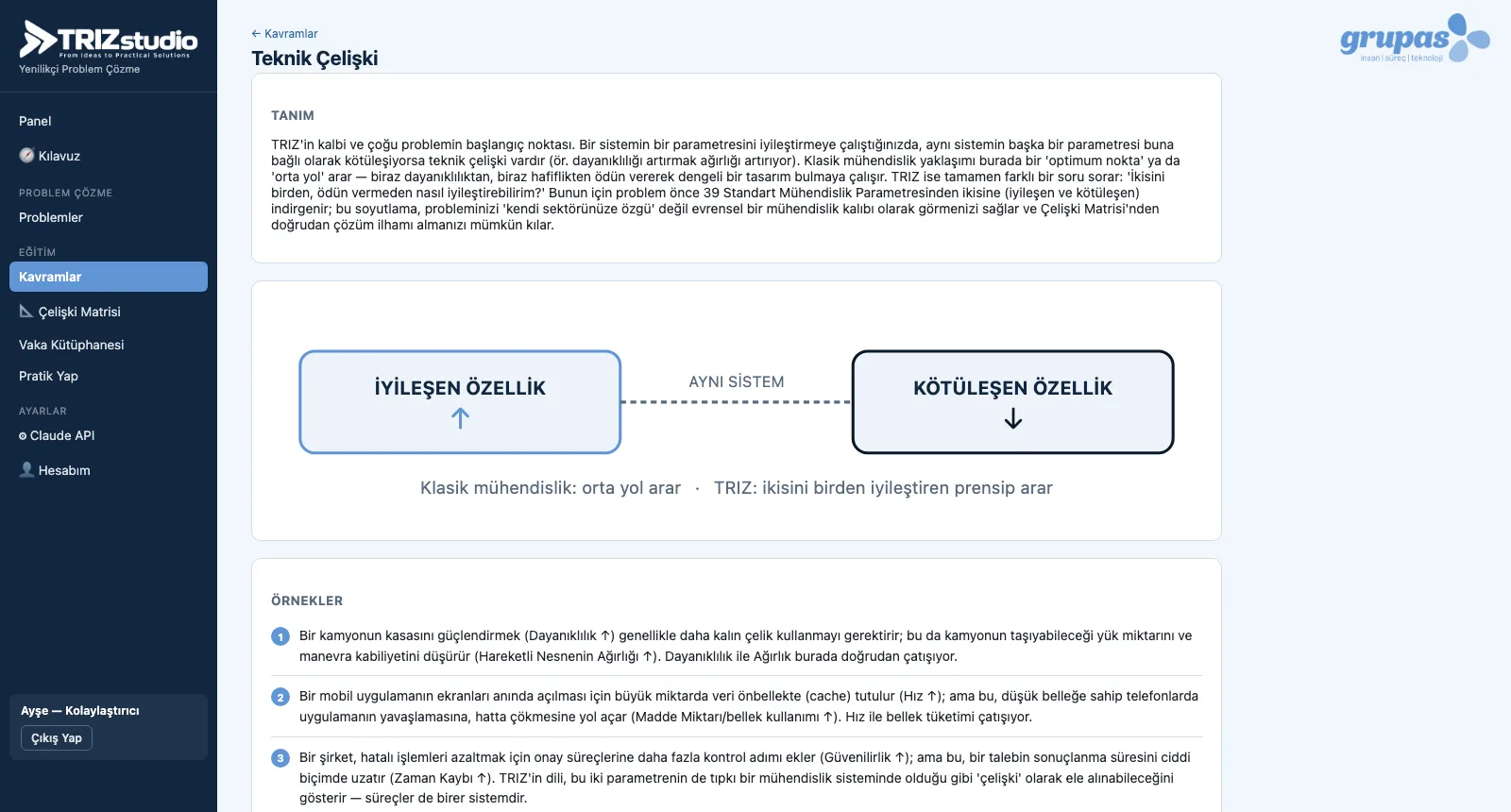
The training section explains the core TRIZ concepts with diagrams and examples, and provides full reference pages for the 40 inventive principles, the 39 parameters and the contradiction matrix. The case library comes with example cases from different fields and lets you add your own. In the practice section grupas.ai creates a short scenario illustrating a principle, and you guess which principle it is.
- 9 core concepts: technical and physical contradiction, IFR, the 40 principles, contradiction matrix, Su-Field, ARIZ, evolution trends, psychological inertia
- Definition, diagram and examples for each concept
- Reference pages: the 40 inventive principles (with explanations and examples), the 39 parameters, the full contradiction matrix
- Case library: ready-made example cases and your own; each case shows the principles used and a contradiction diagram
- Practice exercise: a grupas.ai scenario, guess the principle, see the right answer and explanation; correct answers are counted
Solve your problem in TRIZ studio
Write to us for a live walkthrough on a sample problem.